
This article will explain how to read job descriptions properly. Most job seekers read a posting like a checklist: do I have this skill, yes or no? That approach misses the point. Every job description is a company quietly admitting something is broken. This article teaches you how to read job descriptions and decode them. Read a job description the way a career coach reads one: spotting the pain hiding behind the bullet points, naming the real problem the role exists to solve, and matching your experience to that problem before you ever walk into the interview. Includes real before-and-after examples, common mistakes, and an FAQ section to help you apply this immediately.
This article is the deep-dive companion to The Major Job Interview Problem: How to Fix the “So What?” Problem, which introduced the idea that job descriptions are symptom reports, not task lists. Here, we’re going to slow that idea down into an actual worksheet you can run through tonight, before your next application goes out.
Job descriptions are rarely as straightforward as they look.
Behind the recycled language, ambitious wish lists, and familiar phrases such as “fast-paced environment” or “strong communication skills” is a more important question:
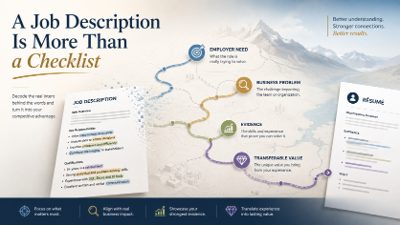 How to Read Job Descriptions: What problem is this company actually trying to solve?
Most job seekers do not stop there. They find a promising position, scan the qualifications, and open their résumé.
They add a few keywords. They move the most closely related experience higher on the page. They remove older work that seems less relevant. Perhaps they ask AI to compare their résumé with the posting.
But before changing anything, it is worth asking why the company is hiring in the first place.
A job description is more than a list of duties and qualifications. It is an imperfect collection of clues about something the employer needs to improve, build, protect, or fix.
You do not need to spend hours investigating every posting. Start with three questions:
Read Job Descriptions: What do they need? So what? What proves I can help?
Those questions can help you move beyond matching words and begin building a more persuasive case for your candidacy.
What Do They Need?
Read the posting once without trying to connect every line to your résumé.
Then read it again and identify the three or four ideas that seem to carry the most weight.
Pay attention to:
- ideas mentioned more than once;
- specific numbers, deadlines, systems, or performance standards;
- words such as build, improve, reduce, increase, scale, streamline, or transform;
- and references to risk, quality, compliance, accuracy, escalation, or growth.
You are not trying to analyze every bullet equally. You are trying to determine what seems most important.
I recently tested this process on a Career Coaching Director posting for a growing, technology-enabled career-services company.
At first glance, the title suggested that the company wanted a highly experienced career coach.
But the description went much further. It emphasized hiring and training coaches, tracking performance, improving workflows, maintaining accurate client records, resolving difficult client issues, and helping the department grow without sacrificing service quality.
It also included response-time expectations, regular client check-ins, and a target for limiting the number of clients receiving no interviews in a given week.
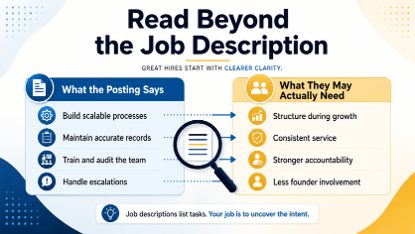
The company was not simply looking for someone who could coach well. It appeared to need someone who could make the entire coaching operation more consistent, measurable, responsive, and scalable.
Fidelity Careers describes a job description as a story about an unmet need. That is a useful starting point: What need is the employer trying to fill, even if the posting does not communicate it perfectly?
“Speak Like an Employer: Decoding Job Descriptions: https://jobs.fidelity.com/en/life-at-fidelity/our-stories/career-advice/decoding-job-descriptions/
Ask “So What?”
This helps fix the “So What Problem.” Once you identify the strongest requirements, ask “So what?” after each one.
Suppose the posting says:
Maintain accurate client records.
So what?
Because incomplete information could lead to missed follow-ups, inconsistent service, confused team members, dissatisfied clients, and poor visibility for management.
The posting says:
Build scalable processes.
So what?
Because the current process may depend too heavily on individual effort or founder involvement. It may work while the company is small, but it begins to break down as the client base grows.
The posting says:
Train and audit coaches.
So what?
Because the quality of service may vary depending on which coach a client receives.
Another way to ask the same question is:
What would go wrong if nobody did this well?
That question can make the underlying need easier to see.
For example, a posting may say:
Coordinate cross-functional projects and ensure alignment across teams.
That could mean more than scheduling meetings. Projects may be stalling during handoffs. Departments may be working toward conflicting priorities. Deadlines may be missed because ownership is unclear.
The employer may need someone who can bring structure and accountability to work that crosses organizational boundaries.
You do not know that any of these explanations are true. You are developing hypotheses.
There is a difference between saying:
The company is disorganized.
and saying:
The repeated emphasis on workflows, record accuracy, response times, and process compliance may indicate that the company is seeking greater consistency as it grows.
The second statement gives you something to investigate without pretending you know what is happening inside the organization.
Read Job Descriptions: What Business Problem Might Be Behind the Posting?
Many job descriptions point toward familiar business conditions.
The company may be:
- growing faster than its systems or staff can support;
- trying to bring consistency to an uneven process;
- launching a new service, product, market, or department;
- dealing with customer dissatisfaction;
- relying too heavily on a founder or senior leader;
- trying to improve an underperforming team;
- reducing errors, delays, or risk;
- or attempting to coordinate departments that do not work together effectively.
You are not trying to become a corporate detective. You are simply trying to understand why the employer is willing to pay someone to do this work.
In the Career Coaching Director example, the company combines coaching, résumé and LinkedIn support, interview preparation, AI-assisted job applications, automated follow-up, and high-volume application activity.
That context suggests that the director would not be overseeing isolated coaching conversations. The person would be working inside a service involving coaches, clients, technology, records, response times, application activity, and measurable results.
That raises useful questions:
- How is coaching quality evaluated?
- How are applications matched to each client’s goals?
- What happens when high activity is not producing appropriate interviews?
- How much authority do coaches have to adjust the strategy?
- What kinds of client problems typically reach the director?
Research should help you ask better questions. It should not turn assumptions into facts.
The same analysis will also improve your interview preparation. Once you understand what may be driving the hire, you can select more relevant accomplishment stories and ask sharper questions about what success will require.
What Proves I Can Help?
Only after you have a working idea of what the employer needs should you turn to your résumé.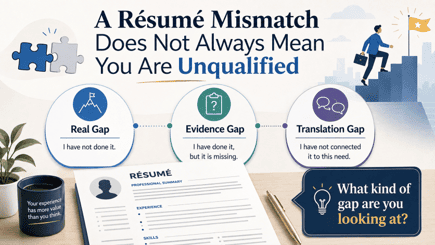
Do not begin by asking:
Have I held this exact title?
Ask:
Where have I handled a similar problem?
The evidence may come from another industry, an older position, a special project, consulting work, volunteer leadership, or an accomplishment hidden beneath an unrelated title.
This is where conventional résumé advice can lead us astray.
I know because I followed it.
After moving into career coaching, I created a résumé focused almost entirely on coaching. It emphasized private clients, outplacement consulting, résumé and LinkedIn development, workshops, networking, interview preparation, and career-transition support.
That seemed logical. I wanted to be considered for career-coaching work, and I had heard the usual advice: Include only experience relevant to what you want to do next.
But when I compared that résumé with the Career Coaching Director posting, I realized I had defined relevance too narrowly.
The employer did not need only coaching expertise. It appeared to need team leadership, startup judgment, process development, performance accountability, client escalation management, and experience helping an organization grow.
Much of my strongest evidence for those needs was in my earlier business career.
An older résumé showed experience building a formal function for a startup, managing direct reports, leading a nine-member team, handling substantial budgets, developing forecasts and processes, introducing technology, negotiating contracts, and supporting growth.
In trying to make my résumé look relevant, I had edited out part of what made me valuable.
A better rule is:
Include the experience that demonstrates your ability to address the employer’s most important needs, regardless of where—or under which title—you developed it.
Strip Away the Job Titles
Job titles become mental containers.
You may think:
- I was a marketing director.
- I was a project manager.
- I was an instructor.
- I was a career coach.
Then you assume the title already explains your value.
It does not.
Temporarily strip away the title, employer, and industry. Then ask:
- What problem or condition did I encounter?
- What did I create, improve, organize, or change?
- What people, decisions, budgets, or resources did I manage?
- What changed because of my contribution?
Then look for capabilities that repeat across different roles.
Building a scientific marketing department is not the same as leading career coaches.
But both situations may require someone who can create structure, set expectations, develop people, allocate resources, solve escalated problems, and support growth.
Transferable experience is not established by pretending that two jobs were identical.
It is established by identifying the common challenge, explaining what carries over, and acknowledging what still needs to be learned.
Read Job Descriptions: Is It a Real Gap, an Evidence Gap, or a Translation Gap?
Once you compare the employer’s needs with your résumé, you will probably find mismatches.
Do not immediately conclude that you are unqualified. Ask what kind of gap you are looking at.
A real gap
You have not performed the work or developed the capability.
In my example, my materials did not establish experience managing Airtable or leading a high-volume, AI-enabled job-application operation.
I may be able to learn those systems, but I should not claim experience I do not have.
An evidence gap
You have the experience, but your résumé does not show it.
My coaching-focused résumé minimized my formal management experience, startup background, budget responsibility, forecasting, team leadership, and process-development work.
The capabilities existed. The evidence was missing from the document.
A translation gap
The experience appears somewhere in your background, but you have not explained why it matters to this employer.
Building a marketing function for a startup may be relevant to building a growing coaching function. But I would need to explain the parallel rather than expect the employer to make the connection independently.
This gives you a quick test:
Have I never done this? Have I failed to show it? Or have I failed to explain why it matters here?
That question can keep you from underselling yourself. It can also prevent you from stretching your experience beyond what it honestly supports.
Recover the Evidence
Sometimes you know you have done relevant work, but you can no longer remember enough detail to present it convincingly.
Once you identify an experience that may support your candidacy, use the CAR framework to reconstruct the challenge, your actions, and the result.
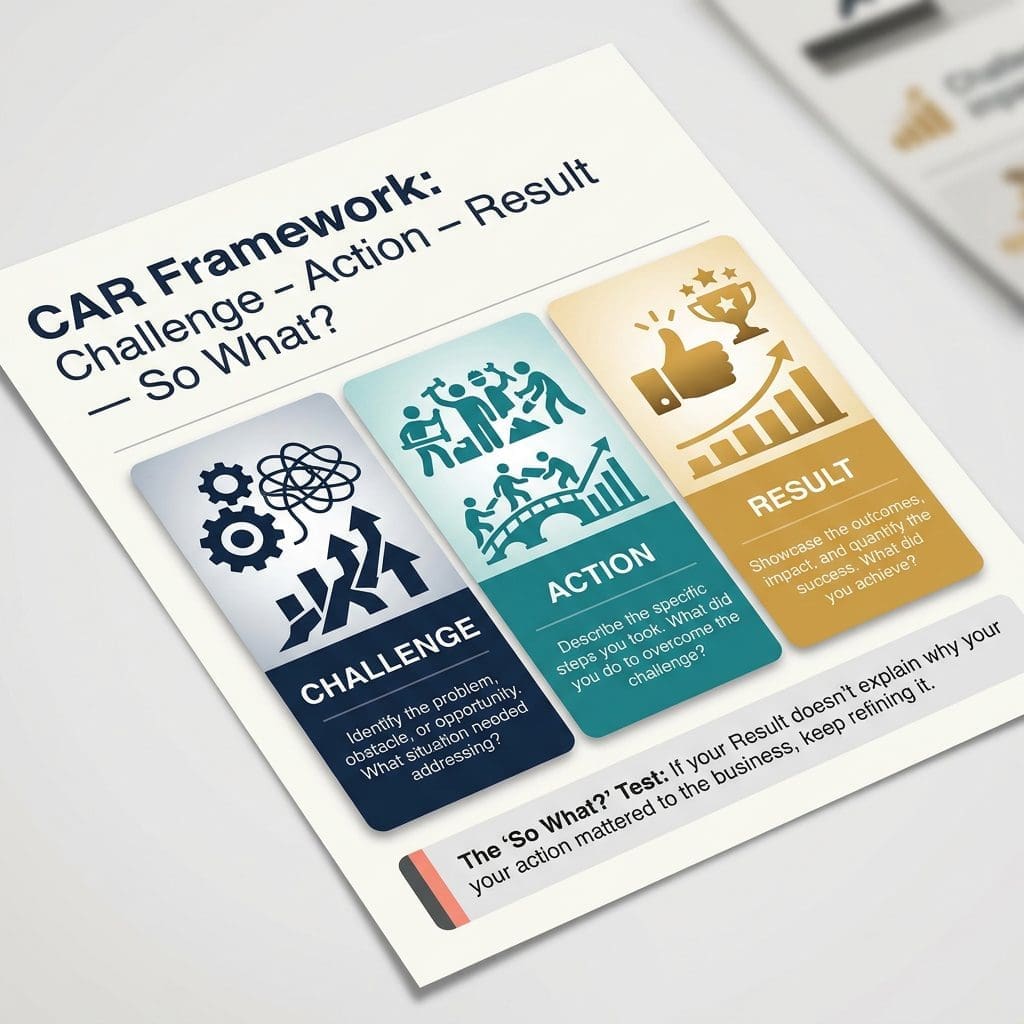
Then add one more question:
What evidence can still substantiate the story?
Evidence might include an old résumé, a performance review, an annual report, a former colleague, customer feedback, or a public record.
Metrics establish scale and context. They do not have to be dramatic.
Useful numbers might include:
- team size;
- number of direct reports;
- budget responsibility;
- client volume;
- satisfaction scores;
- services or courses added;
- products launched;
- markets entered;
- or approximate business growth.
Do not manufacture precision. Use honest language such as approximately, contributed to, helped support, or played a role in.
But do not discard a meaningful accomplishment simply because you no longer possess every number.
Better yet, document successes when they occur. Capture the challenge, what you did, what happened, and any numbers that establish scale. The notes do not need to be polished. They only need to preserve the raw material.
Claim Your Contribution, Not Control Over Everything
Some results depend on many people and conditions.
A career coach can directly influence clarity, positioning, résumé quality, interview preparation, networking strategy, confidence, accountability, and job-search execution.
A coach cannot fully control interviews, offers, compensation, hiring timelines, employer decisions, or the labor market.
The same principle applies in other professions. A marketing leader does not single-handedly create company revenue. A project manager does not control every outcome of a cross-functional initiative.
That does not mean you should avoid discussing results.
Describe your contribution accurately. Explain what changed. Respect the limits of your control.
Read Job Descriptions: Use the Five-Minute Decode
This process does not need to become a burden.
For most opportunities:
- Find the three strongest requirements.
- Ask “So what?” or “What would go wrong if nobody did this well?”
- Complete: “They appear to need someone who can ______ because ______.”
- Find one example from your background for each priority.
- Decide whether each mismatch is a real, evidence, or translation gap.
That may be enough to decide whether the opportunity is worth pursuing, which version of your résumé to use, and which accomplishments deserve the most attention.
Go deeper when the opportunity is especially attractive, senior, competitive, or closely aligned with your goals.
Use AI as an Analyst, Not an Oracle
AI can help you move through the process more quickly.
Try:
Analyze this job description and identify the employer’s three to five likely priorities. Show the language supporting each conclusion and label it as a fact, supported hypothesis, or unanswered question. Then compare those priorities with my résumé. Identify what is clearly demonstrated, partially demonstrated, and not demonstrated. Do not invent experience or assume that a missing résumé detail means I lack the capability.
Then ask:
For each mismatch, classify it as a possible real experience gap, evidence gap, or translation gap.
AI can recognize patterns, compare documents, and surface connections you may have missed.
It cannot know what the hiring manager is thinking. It cannot know whether an undocumented experience occurred. And it can produce a polished answer that sounds more certain than the evidence warrants.
Ask it to show its evidence and uncertainty—not simply give you an answer.
Customize Your Case, Not Just Your Wording
A job description is an imperfect treasure map.
Some clues may be vague, generic, outdated, or unrealistic. But the posting can still help you understand what the employer values and what may be driving the hiring decision.
Start with three questions:
Read Job Descriptions: What do they need? So what? What proves I can help?
 Then examine every mismatch.
Have you truly never done the work?
Have you done it but left out the evidence?
Or have you failed to explain why experience from another role or industry matters here?
Do not customize your résumé only to the title, the keywords, the ATS, or the most obvious version of your professional identity.
Customize your employment case to the needs behind the posting.
The goal is not to make your résumé sound more like the job description.
It is to build a credible bridge between the employer’s problem and the full value you bring.
Read Job Descriptions: Ready to Decode Your Next Opportunity?
A job description can tell you far more than which keywords to add to your résumé. When you understand what the employer really needs, you can identify the experience that matters most, uncover value you may have overlooked, and build a stronger case for why you are the right person to help.
If you would like help decoding a target position and connecting it to the full value you bring, schedule a complimentary discovery session. Together, we can look beyond the job title, identify the employer’s likely priorities, and determine how to position your experience more effectively.

About the Author
 Deb Oronzio is a career transition coach, business professional, and founder of Self-Empower Coaching, where she helps professionals navigate career change with clarity, confidence, and purpose. Drawing from her own career reinventions, Deb brings empathy and practical, real-world insight to every client relationship, helping people move beyond feeling stuck and toward work that fits who they actually are.
Sources
Doyle, A. (2024, November 12). How to use the STAR interview response method. The Balance. https://www.thebalancemoney.com/what-is-the-star-interview-response-technique-2061629
Harvard Business Review. (2021, October 5). A guide to preparing for your next job interview. Harvard Business Review. https://hbr.org/2021/10/a-guide-to-preparing-for-your-next-job-interview
Kelley, T. (2025, August 7). How to read a job posting the REAL way. Thea Kelley Career Services. https://jobsearchandinterviewcoach.com/how-to-read-a-job-posting-the-real-way/
Mac’s List. (2018, August 8). How to read between the lines of a job posting, with Justin Dux [Podcast transcript]. https://www.macslist.org/podcasts/setting-goals/how-to-read-between-the-lines-of-a-job-posting-with-justin-dux
Nordin, A. (2023, September 14). How to read between the lines of a job posting. LinkedIn. https://www.linkedin.com/pulse/how-read-between-lines-job-posting-alice-nordin

0 Comments