
If you have ever walked out of an interview thinking, “I answered every question — so why didn’t I get a callback?” you have likely run face-first into the single most common major job interview problem out there. It is not nerves. It is not your résumé. It is that your answers described what you did without ever explaining why it mattered. This article breaks that problem down in plain language and gives you a clear, step-by-step path to fixing it — before your next interview.
What Exactly Is the “So What?” Problem?
Picture two candidates interviewing for the same project management role. Both have five years of experience. Both arrive on time. Both are perfectly polite. One gets the job. One gets a vague email about “moving forward with other candidates.”
The difference? One of them answered the unspoken question hiding inside every single interview question: So what?
The “So What?” problem happens when candidates stop at describing their job duties without ever explaining the impact, relevance, or value of those duties to the role in front of them. It is the single most common major job interview problem that coaches like me see — and it is invisible to the person doing it.
“Most people prepare answers. Very few prepare evidence.”— Deb Oronzio, Self-Empower Coaching.
Let me tell you a little story. Earlier today, I was working with someone who had an interview coming up. He had prepared. I had given him a few common questions ahead of time, and he came ready to answer them.
But as we started the mock interview, something became clear almost immediately. His answers weren’t wrong. They just weren’t compelling.
He was pulling from real experience, but it came out scattered. It was more like a collection of things he had done than a clear explanation of what he actually brought to the table.
At one point, I stopped him and said, “You’re not unprepared. You’re just preparing at the wrong level.”
Because that’s the issue I see over and over again: people prepare for interviews by thinking through answers. They review their resumes. They try to sound polished.
But when it’s time to speak, they fall back on describing what they’ve done. They describe tasks, responsibilities, and job duties without ever clearly showing why any of it matters.
I call this the “so what?” problem, and most people never get past it. Most people prepare answers. Very few prepare evidence.
There is a meaningful difference between these two types of interview responses:
The first answer is accurate. The second answer is compelling. The difference is not talent or experience. It is preparation at the right level.
Where Does This Major Job Interview Problem Actually Begin?
Here is the part that surprises people: this major job interview problem does not start in the interview room. It starts weeks earlier, the moment you first read the job description.
Most job seekers scan a posting and play a quick mental match game:
- “I’ve done that.” ?
- “I know that tool.” ?
- “I can learn that.” ?
- Apply. Done.
But here is the question almost no one asks at that stage: “What problem is this role actually trying to solve?”
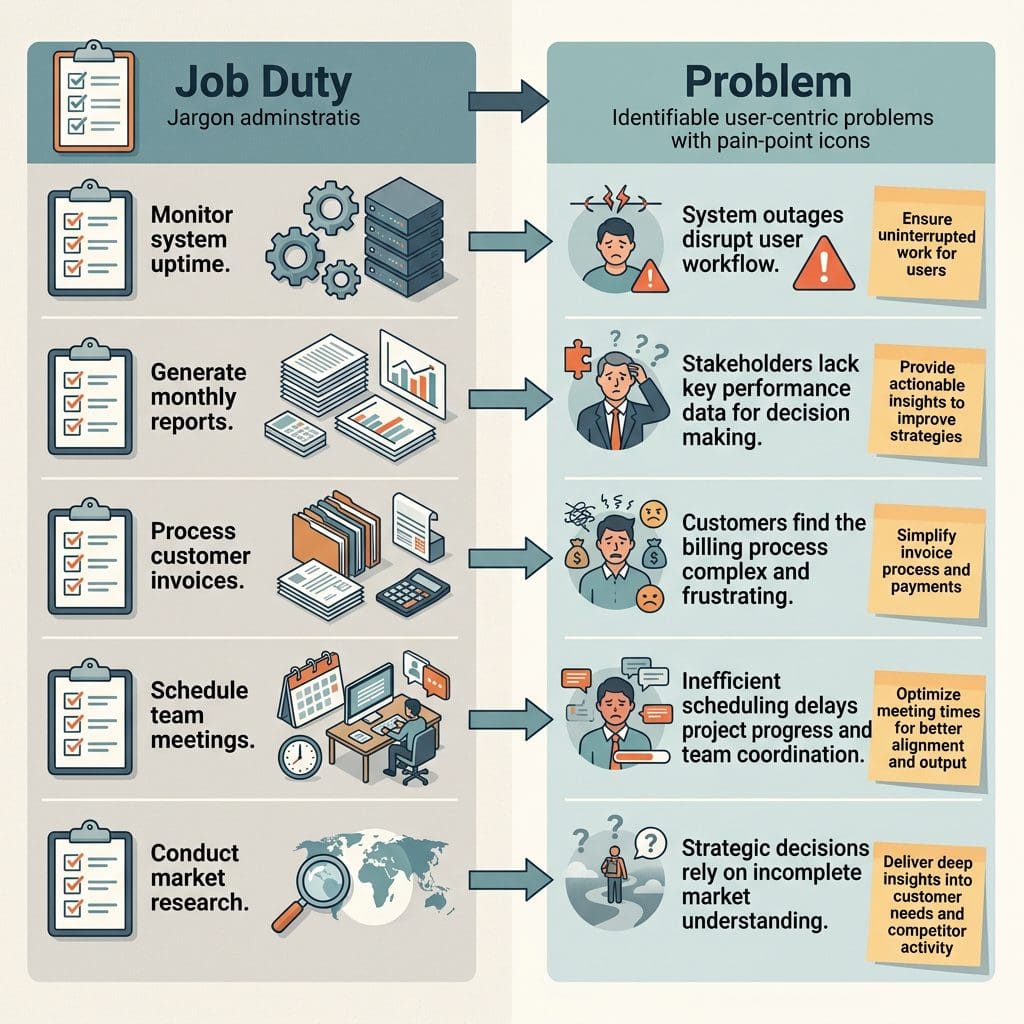
A job description is not a checklist of tasks. It is a symptom report. Every bullet point is the company’s way of saying: something isn’t working the way it should, and we need someone who can fix it.
When you only ask “Am I qualified?” instead of “What pain point am I being hired to solve?”, you walk into the interview prepared to describe yourself — but unprepared to sell yourself. This is exactly the major job interview problem you face.
- ~30s – Average time before an interviewer forms a first impression
- 20% – Of candidates connect their experience to measurable outcomes
- 3x – More memorable: impact-based answers vs. task-based answers
How Do You Read Between the Lines of a Job Description?
Learning to decode a job description is a skill. Once you have it, you will never read one the same way again. Think of it like being a translator. The company writes in “job duty” language. You need to translate it into the “problem to be solved” language.
Here is a practical framework:
First time: understand what they are asking for. Second time: ask yourself why this exists. What would go wrong without this role?
Are multiple bullets pointing to the same problem — like miscommunication, slow processes, or inconsistent quality? That pattern is the real job.
Give it a simple label: “This role is about bringing order to a chaotic process” or “This role is about rebuilding team trust after a period of turnover.”
Now pull experiences from your background that speak directly to that underlying problem — not just the surface-level task list.
That shift in interpretation changes everything about how you prepare your answers.
How Do You Connect Your Experience to What Actually Matters?
Once you understand the real major problem the company is trying to solve, the next step is to build what I call evidence-based answers—not just answer-based ones.
Most candidates tell interviewers what they did. Evidence-based answers show interviewers what changed as a result of their actions.
The CAR Framework
You have probably heard of the CAR method (Challenge, Action, Result). It is a good starting point. But the version that fixes the major job interview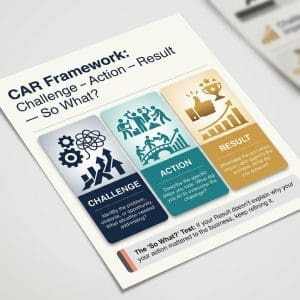 problem adds one more step: the “So What?” at the end.
-
Challenge: Briefly describe the problem or situation you faced. What was the goal, and what stood out as a hurdle?
-
Action: This is the “meat” of your answer. Detail the specific steps you took to address the challenge. Focus on your individual contribution, even if it was a team effort.
-
Result: Quantify the outcome. What happened because of your actions? Use numbers, percentages, or specific praise whenever possible.
The “So What?” Test: If your Result doesn’t explain why your action mattered to the business, keep refining it. This final step is what separates the candidates who get called back from the ones who do not.
“You don’t need a percentage or a dollar figure to prove your value. You need to point out a change. What improved? What became possible because of you?”— Deb Oronzio, Self-Empower Coaching
What If You Do Not Have Hard Metrics?
This is the most common concern I hear, especially from people in behind-the-scenes roles. And here is the truth: metrics are nice, but they are not required.
Consider these metric-free but still compelling results:
- “The team stopped missing weekly reporting deadlines.”
- “New hires started getting up to speed in half the time.”
- “My manager no longer had to step in to manage client conflicts directly.”
- “The project got back on track after three months of delays.”
Each of those is a result. Each answers the “so what?” Even without a spreadsheet to back it up.
Why Do So Many Qualified People Miss Their Own Value?
Here is where things get a little uncomfortable — and important.
Most people do not undersell themselves because they are not skilled. They undersell themselves because they have never been asked to look at their work differently.
This is especially true for people in roles that operate behind the scenes — project managers, executive assistants, technical specialists, coordinators, operations folks. These are the people keeping the engine running while everyone else drives the car. Their work is essential. But it is rarely visible. And because visibility is low, the habit of connecting work to outcomes never develops.
So when an interviewer asks, “What was the impact of your work?” the honest answer feels like: “I… did my job?”
That is not a lack of value. That is a lack of practice in articulating value. And practice is fixable.
“The major job interview problem is not that you lack value. It is that you have not yet learned to speak the language of value.”— Deb Oronzio, Self-Empower Coaching
There is also a confidence loop at play here:
- You are not sure what your impact really was.
- So you hedge. You use vague language. You stay at the task level.
- The interviewer hears uncertainty.
- You pick up on their lukewarm response.
- You feel less confident for the rest of the interview.
The loop starts with unclear thinking about your own value — and ends with a missed opportunity. The good news? It also works in reverse.
How Do You Start Seeing Your Own Value Differently?
This is the practical work. This is where preparation becomes powerful. And it starts with better questions — not better answers.
The next time you sit down to prep for an interview, do not just rehearse what you did. Instead, run through these questions for each major responsibility or project you plan to mention:
- What did my work make possible for others?
- What improved because I did this consistently and well?
- What would have gone sideways if I had done this poorly — or not at all?
- Who benefited? My manager? My team? A client? The company’s bottom line?
- What changed between before I took on this responsibility and after?
Work through one responsibility at a time. Write down the answers. You do not need eloquent prose. Bullet points work fine. What you are building is a value inventory: a personal evidence file that you can draw from in any interview.
A Practical Exercise You Can Do Right Now
Just one. Something you did regularly, maybe something you never thought was impressive.
Write it out the way you would on a résumé: “Managed weekly status reports across four departments.”
Seriously, say it out loud. It forces a real answer instead of a polished non-answer.
“Because of those reports, leadership had a clear picture of blockers before they became crises. My manager stopped getting surprised by delays.”
Now you have a toolkit of compelling, evidence-based stories ready to pull from in any interview — no matter how the question is phrased.
What Does Real Interview Confidence Actually Look Like?
Confidence in an interview is not about a power pose in the parking garage beforehand. It is not about memorizing a script. And it is definitely not about performing calm when you are internally screaming.
Real confidence is the byproduct of having done the right kind of preparation — the kind that goes deeper than rehearsed answers and touches something true about your actual contribution.
When you can clearly connect:
- What they need (decoded from the job description)
- To what you have done (your real experience)
- To why it matters (the “so what?” answer)
…you stop guessing whether you are a fit. You know you are a fit — and that knowing comes through in how you speak, how you pause, and how you respond to follow-up questions without stumbling.
That is not performance. That is the natural result of having done the work.
“Confidence is not something you perform. It is something that shows up when you have done the right kind of preparation.”— Deb Oronzio, Self-Empower Coaching.
Think of it like this: imagine you are asked to explain something you know inside and out; your favorite hobby, your hometown, a project you poured yourself into. You do not pause. You do not hedge. You just talk. That is what real interview confidence feels like. And the path there is preparation — the right kind.
What Is a Simple Action Plan to Get Interview-Ready?
Pull this checklist out before your next interview. Do not skip steps because they feel obvious — the ones most people skip are the ones that feel obvious.
- Decode the job description. Read it twice. For each major responsibility, ask: “What problem exists that makes this necessary?”
- Name the role’s real job in one sentence. Example: “This role is about stabilizing a team that has experienced a lot of turnover.”
- Build your value inventory. Pull 5–8 experiences from your history and run each one through the “So What?” exercise above.
- Practice out loud — not just in your head. Your brain thinks faster than your mouth. The gap between “I know what I want to say” and “I can say it clearly” only closes with out-loud practice.
- Prepare questions that reflect your research. Questions that show you understand the real problem the role exists to solve are far more impressive than generic “what does success look like here?” questions.
- Do a pre-interview review of your value inventory. Spend 15 minutes before the interview reading through your evidence — not to memorize it, but to reconnect with it.
That is the whole system. This will solve the major problem in job interviews. It is not complicated. It just requires thinking most people skip because it feels uncomfortable to examine your own work that closely.
If you find yourself stuck — if the “So What?” question keeps leading you back to vague answers — that is not a sign that you lack value. It is a sign that you need a thinking partner. That is exactly what coaching is for.

Frequently Asked Questions
What is the “So What?” problem in a job interview?
How do I fix the “So What?” problem if I don’t have impressive metrics?
How is the CAR method related to the “So What?” problem?
Why do I feel confident in my experience but blank out during interviews?
How early should I start preparing for an interview?
What if I am in a behind-the-scenes role and my impact is hard to see?
Is this advice only for unemployed people and job hunting?
Further Reading
The following sources were consulted and are recommended for readers who want to go deeper on interview preparation, value articulation, and professional communication.
- Doyle, A. (2024, November 12). How to use the STAR interview response method. The Balance. https://www.thebalancemoney.com/what-is-the-star-interview-response-technique-2061629
- Harvard Business Review. (2021, October 5). A guide to preparing for your next job interview. Harvard Business Review. https://hbr.org/2021/10/a-guide-to-preparing-for-your-next-job-interview
- Indeed Editorial Team. (2025, January 8). How to prepare for an interview: A step-by-step guide. Indeed Career Guide. https://www.indeed.com/career-advice/interviewing/how-to-prepare-for-an-interview
- Pink, D. H. (2012). To sell is human: The surprising truth about moving others. Riverhead Books.
- LinkedIn Talent Solutions. (2024). Global talent trends report 2024. LinkedIn. https://business.linkedin.com/talent-solutions/global-talent-trends
Deb Oronzio
 Deb Oronzio is a career transition coach, business professional, and founder of Self-Empower Coaching, where she helps professionals navigate career change with clarity, confidence, and purpose. With a strong belief in continuous learning, resilience, and personal reinvention, Deb guides individuals through meaningful career transitions, whether they are seeking advancement, a new direction, or greater fulfillment in their work.
Drawing from her own diverse professional journey and career reinventions, Deb brings empathy, practical insight, and real-world experience to her coaching approach. She is passionate about helping clients identify their strengths, reconnect with their goals, and create actionable strategies for long-term career success.
Through personalized coaching, career exploration, and professional development guidance, Deb empowers professionals to move beyond feeling stuck and toward careers aligned with their values, skills, and aspirations. Her work focuses on helping clients build confidence, embrace change, and develop the resilience needed to thrive in today’s evolving workplace.
Deb is known for her supportive, encouraging coaching style and her commitment to helping others unlock their potential and create meaningful professional lives.


0 Comments