Tired of sending “black hole resumes”? Learn why human connection, proximity, and positioning still matter in a modern job search. This article is based on my own professional insights.
How many hours would you invest in creating an important work product only to throw it into a black hole?
Think about it. Are you suffering from the black hole resume syndrome?
If your boss assigned you a critical report or a major proposal, or if you were writing a master’s thesis or doctoral dissertation, you would invest time, effort, and thought into creating something meaningful. You would expect someone to read it, evaluate it, discuss it, or at the very least acknowledge that it exists.
Yet every day, job seekers spend hours tailoring resumes, rewriting summaries, optimizing keywords, and carefully aligning their experience with a specific opportunity, only to upload the document into a system and never hear another word. This is the black hole resume!
No conversation, no feedback, no acknowledgment – ghosting.
If you’ve ever felt frustrated by that process, you’re not alone.
The modern job search has become increasingly efficient from a technology standpoint. Unfortunately, it has also become increasingly disconnected from the way human beings naturally build trust, credibility, and opportunity.
And that’s a problem.
The Black Hole Resume Syndrome: Your Resume Is Important—But It Was Never Intended to Do All the Work
Let me be clear: your resume matters.
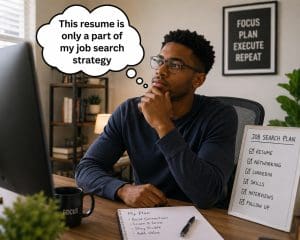 A well-written, well-positioned resume is still your entry ticket. It demonstrates your qualifications, highlights your accomplishments, and helps employers understand whether your background aligns with their needs.
You should absolutely invest time in creating a strong resume.
The problem begins when the resume becomes your entire strategy.
Many job seekers spend the vast majority of their time:
- revising resumes,
- tweaking LinkedIn profiles,
- optimizing keywords,
- chasing ATS scores,
- and submitting online applications.
Those activities are necessary.
They are just not sufficient.
After working with job seekers for many years, I’ve noticed that people often treat the resume as if it is responsible for carrying the entire burden of their professional identity.
It can’t. A resume is a document. You are a person.
And human beings are far more complex than documents.
Human Beings Are Not Flat Documents
Think about the people who have made an impression on you throughout your career.
Did you remember them because of a bullet point on a resume?
Probably not.
You remembered them because of: 
- a conversation,
- a story,
- their energy,
- their perspective,
- their confidence,
- their curiosity,
- or the way they made you think.
Human beings are wired for connection. We remember experiences. We remember conversations. We remember how people made us feel.
Yet much of today’s job-search process attempts to reduce human beings to keywords, algorithms, and application forms.
Technology may help employers process information faster, but it does not change human nature.
At the end of the day, people still hire people.
Artificial intelligence (AI) may change how work gets done and how information is processed, and it may even eliminate some repetitive tasks.
But it will not eliminate the human need for trust, credibility, relationships, communication, judgment, and connection.
Those qualities are becoming more valuable, not less.
Avoid The Black Hole Resume Syndrome: The Real Opportunity Is Positioning
One of the concepts I’ve emphasized throughout my coaching practice is positioning.
Long before AI became part of every career conversation, I was helping people understand the importance of identifying their value and communicating it effectively.
In marketing, positioning is everything.
The best product in the world can struggle if people don’t understand what makes it valuable.
The same principle applies to your career.
You need to understand what you do well, what problems you solve, what value you create, and why someone should choose you over another candidate.
That isn’t arrogance. It’s clarity. And clarity creates confidence.
The challenge is that positioning requires more than a resume. Positioning requires interaction.
Which brings us to a word many people dislike.
Networking.
Avoid The Black Hole Resume Syndrome: Maybe It’s Time to Rethink Networking
For some people, networking feels awkward, forced, or even manipulative.
I understand why.
Unfortunately, the word has accumulated a lot of baggage over the years.
Recently, I heard broadcaster Robin Roberts describe success in terms of proximity and positioning.
I immediately connected with that idea.
Because that’s what effective networking really is—not collecting contacts, asking strangers for favors, or handing out business cards.
Proximity simply means creating opportunities for people to get to know you. Positioning means helping them understand the value you bring.
Together, they create visibility. And visibility creates opportunity.
I’ve seen this play out in real job searches.
Several years ago, while coaching job seekers through an outplacement program, I worked with a woman who was searching for opportunities as a data analyst.
Like many professionals, she was spending time applying online and monitoring job boards. Unlike many job seekers, however, she was willing to step outside her comfort zone and experiment with virtual networking.
Using LinkedIn, she connected with another data analyst who worked at Red Hat here in Raleigh. Red Hat is a respected company, and many job seekers find it notoriously difficult to break into.
Eventually, that online connection led to a phone conversation.
Now here’s the important part.
The conversation did not lead directly to a job. There were no open opportunities that matched her background at the time.
By some people’s definition, that might make the conversation look unsuccessful.
I disagree.
She came away from that conversation with something more valuable than another online application.
She gained insight. She gained confidence. And most importantly, she gained access.
At the end of the conversation, the Red Hat employee told her that if an opportunity appeared in the future that interested her, she should reconnect. They would help her navigate the process.
 A door had opened. Not a job. A door.
And in a successful job search, those doors matter.
One of the biggest mistakes job seekers make is defining success too narrowly. If the only win is getting the job, you’re going to feel defeated most days.
But if success includes building relationships, gathering information, increasing visibility, and creating future opportunities, then many of the actions that seem small in the moment become meaningful steps forward.
Not every conversation leads to a job offer.
Not every informational interview changes your life.
But every meaningful conversation increases your visibility, expands your perspective, and creates possibilities that simply do not exist when you’re sitting alone submitting applications online.
Avoid The Black Hole Resume Syndrome: Why We Keep Returning to Online Applications
If networking and human connection are so valuable, why do so many people spend nearly all of their time applying online?
Because it feels safer, submitting applications lets you remain anonymous.
There is no awkward conversation. No vulnerability. No risk of feeling exposed. You can stay behind the screen.
That’s human nature.
When we feel uncertain, we often gravitate toward activities that feel familiar and controllable.
The challenge is that familiar does not always mean effective.
Many job seekers are working incredibly hard. They’re simply investing too much of that effort in places where human connection never has a chance to occur.
Avoid The Black Hole Resume Syndrome: Shift Some of Your Effort Toward Visibility
This is not an argument against resumes. It is not an argument against technology. And it is certainly not an argument against AI.
These tools have value.
The question is whether they have become too large a percentage of your overall strategy.
What would happen if you redirected just a portion of your effort?
What if, instead of spending another hour tweaking a resume, you spent that hour:
- reconnecting with a former colleague,
- scheduling an informational interview,
- participating in a professional group,
- attending an industry event,
- Or expanding your visibility in your field?
Would every conversation lead to a job?
Of course not.
But neither does every application.
The difference is that conversations create possibilities that algorithms cannot.
Making Yourself Easier to Remember
Avoid The Black Hole Resume Syndrome: What is a Networking Brief?
One tool I often recommend is a Networking Brief or Career Brief.
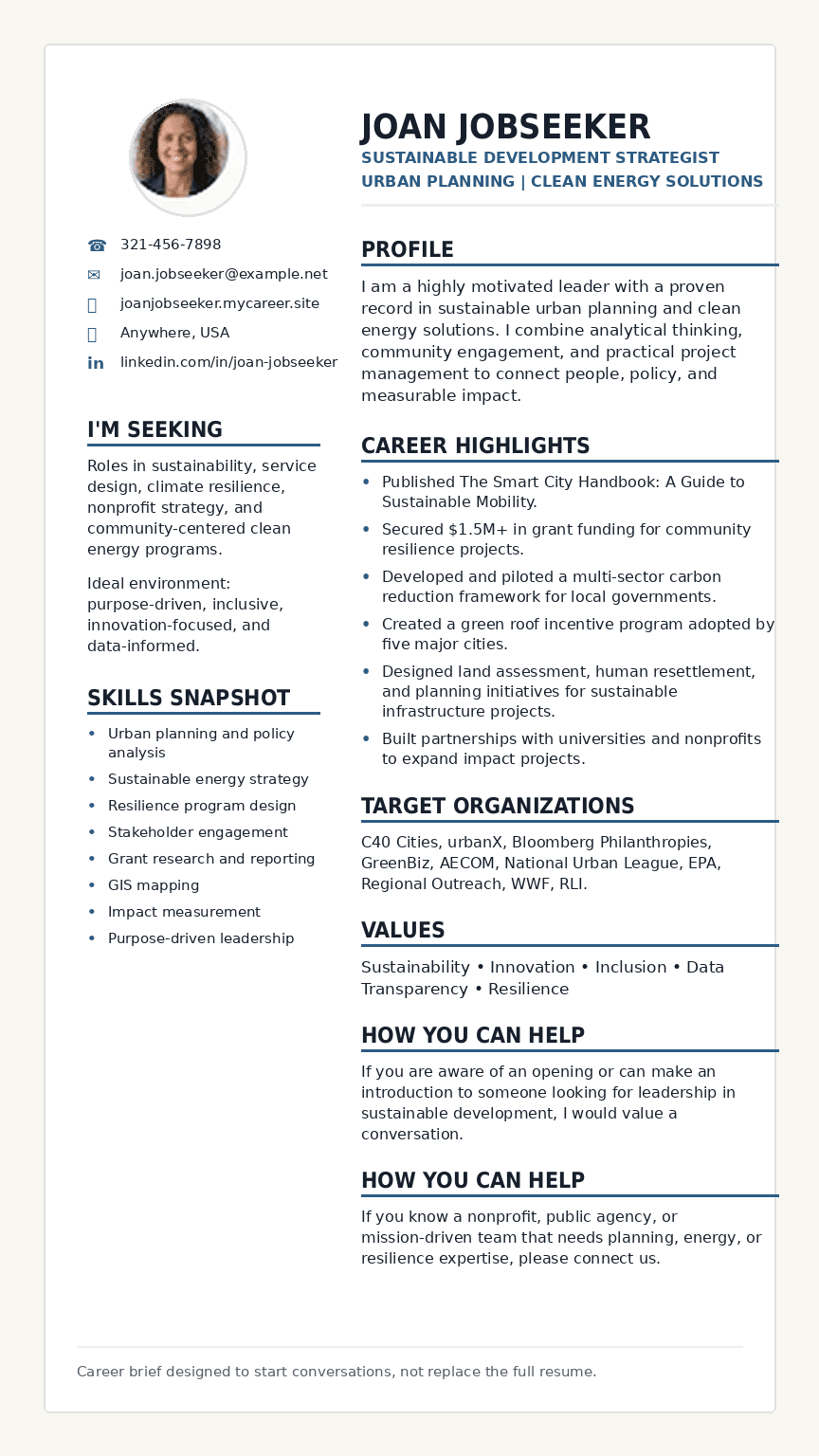
Think of it as a conversation starter rather than a traditional resume.
A networking brief is typically a one-page document that includes a professional summary, key strengths, selected accomplishments, contact information, and a clear picture of the kinds of opportunities you are pursuing.
Unlike a resume, which often documents everything you’ve done, a networking brief helps another person quickly understand who you are, what value you bring, and where you’re headed.
Its purpose is not to replace a resume. Its purpose is to make it easier for another human being to remember you, understand you, and potentially connect you with opportunities that align with your goals.
In other words, it helps support both positioning and visibility.
How to Avoid The Black Hole Resume Syndrome: A Simple Challenge
Over the next five days, commit to one visibility-building activity each day.
Reach out to someone. Start a conversation. Ask a question. Reconnect with an old colleague. Join a discussion. Attend an event.
Do something that creates proximity. Do something that strengthens your positioning. Do something that lets another person see the value you bring.
Because while technology continues to reshape the mechanics of job search, it has not changed one fundamental truth:
People still hire people.
And opportunities often begin long before a job is ever posted.
Sometimes they begin with a conversation.
Ready to Create More Visibility in Your Job Search and Avoid The Black Hole Resume Syndrome?
If you’re spending hours tailoring resumes and submitting applications but not seeing the results you want, it may be time to look beyond the job boards.
Sometimes a small shift in strategy can create opportunities you never knew existed.
If you’d like help clarifying your positioning, strengthening your networking approach, or developing a job search strategy that balances technology with human connection, I’m here to help.
 Deb Oronzio is a career strategist, coach, and founder of Self-Empower Coaching, serving clients in Raleigh, Durham, the Research Triangle, and beyond. Through her work, Deb helps professionals gain clarity, build confidence, and develop purposeful career strategies aligned with their skills, values, goals, and life priorities. Her coaching focuses on helping people move from career uncertainty to career direction, whether they are exploring a transition, preparing for interviews, updating their resumes, strengthening their LinkedIn profiles, or repositioning themselves for a better opportunity.
At Self-Empower Coaching, Deb works with clients to develop a complete career promotional strategy. This may include assessment reviews, personal branding, resume development, LinkedIn profile improvement, interview preparation, networking strategy, company targeting, negotiation preparation, and a customized job search plan. Her goal is not simply to help clients “find a job,” but to help them understand their value, communicate it clearly, and pursue work that offers success, satisfaction, and significance. Job searching is hard enough without making your resume read like a witness protection document.
Schedule a complimentary Discovery Session, and let’s talk through where you are, where you’d like to go, and how to increase your visibility in today’s job market.

The goal isn’t simply to apply for more jobs; it’s to create more opportunities.


0 Comments