 Leaving Behind Old Job-Search Habits to Build Momentum in 2026
If you’re starting 2026 in the midst of a job search, I want to say this upfront: you’re probably not lacking effort.
Most people I talk with are already doing what they’ve been told to do—updating resumes, writing cover letters, applying online, networking where they can, and showing up in job-search communities. Here in the Triangle, we’re fortunate to have a strong ecosystem of free support through libraries, community colleges, faith-based ministries, and large online groups. I’ve worked alongside many of these programs over the years, and I value what they provide.
And still, I hear the same frustration again and again:
“I’m doing everything right. Why isn’t this working?”
That’s the real problem to solve—and it’s exactly what this article is about.
The Myth We’re Ready to Leave Behind
One of the most common beliefs I hear sounds like this:
If I just keep doing the right things consistently, something will eventually break through.
For a long time, that belief made sense. Today, it’s incomplete.
Hiring has changed. The tools have changed. Expectations have shifted. And the job-search habits that used to work by default often don’t create momentum the way they once did.
Why the AI Noise Makes People Feel Stuck
AI is now part of the job-search conversation, whether we like it or not. Some headlines are helpful. Some are alarming. Many are poorly explained.
What I see on the ground is this: AI has made it easier to produce more—more applications, more resume versions, more outreach messages. That can feel productive. But it can also keep you trapped in a cycle of motion without traction.
Used wisely, AI supports judgment.
Used mindlessly, it replaces it.
In 2026, the edge isn’t simply using AI. It’s using it well—while keeping your human clarity front and center.
What a Smarter Reset Looks Like in 2026
A smarter job search doesn’t require you to hustle harder. It requires you to direct your effort more intentionally.
Instead of applying to ten roles in a week and hoping one sticks, you narrow to the two or three roles that truly fit—and you reinvest the time you’ve gained. That time might be spent researching a hiring manager, reaching out to someone on the team, or reconnecting with a former colleague who understands your work. Fewer applications, more intentional conversations, and a clearer sense of alignment tend to lead to better outcomes.
The same shift applies to resumes. Many people tell me their resume is “ready,” and technically, it is. It’s clean, complete, and professional. But readiness isn’t the same as relevance. Small adjustments—emphasizing customer-facing experience for one role or operational problem-solving for another—help employers see fit immediately, rather than having to infer it.
AI fits into this reset as well. I see people use it to endlessly rewrite documents or generate outreach that sounds polished but generic. Used thoughtfully, AI can help organize ideas, surface themes, and tighten language. Used carelessly, it reinforces the habit of doing more instead of thinking more. Employers respond to clarity and judgment—not volume.
Across the Triangle, I’ve watched people attend workshops, participate in online groups, revise materials, and follow advice from multiple sources—sometimes all at once. Momentum shows up when they pause long enough to choose a strategy: what to focus on, what to stop doing, and how they want to be known.
That pause is often the turning point.
Three Actions You Can Take This Week
If you want a practical way to start the year differently, begin here: 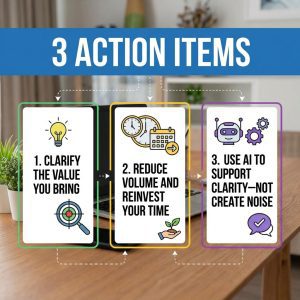
- Clarify the value you bring
Identify three problems you solve well and write one short example for each. - Reduce volume and reinvest your time.
Choose a smaller set of target roles and replace some blind applications with targeted outreach or meaningful conversations. - Use AI to support clarity—not create noise.
Let AI help you brainstorm, outline, and refine. Then edit so the final result reflects your voice and judgment.
A Simple “Smarter Reset” Checklist
Clarity
- I can explain the kind of role I’m targeting in one sentence
- I can name three strengths that directly support that role
- I can point to specific examples, not just traits
Positioning
- My resume highlights what matters most for my target role
- My LinkedIn headline and summary align with what I want next
- I’m not relying on one generic resume for every application
Strategy
- I have a short list of target roles or companies and a reason for each
- I intentionally replace some blind applications with targeted conversations or outreach
- I have a weekly rhythm that balances applying, networking, follow-up, learning, and rest
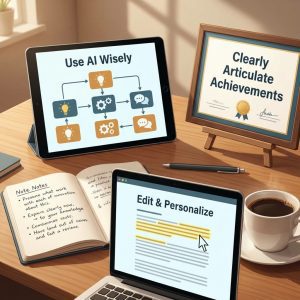 AI (Used Wisely)
- I use AI to brainstorm or organize—not to replace my voice
- I edit AI output so it sounds like me and reflects my judgment
- I can explain my accomplishments clearly without sounding scripted
Momentum
- I’m generating real conversations, not just submissions
- I adjust my approach based on results, not just effort
- I know what I’ll do differently next week if nothing changes
Start the Year With Intention
A new year doesn’t require a harder push. It invites a smarter one.
Free resources, peer support, and technology all have a place in today’s job-search ecosystem. For many people, the turning point comes when they stop trying to do everything and start choosing what works.
Preparation builds confidence.
Confidence gets results.
A Gentle Invitation
If you’ve been doing all the “right” things and still feel stuck, sometimes it helps to step back and talk it through with someone who sees patterns across many job searches—not just one.
I offer a free Discovery Session for that purpose. It’s a no-pressure conversation to help you clarify what’s getting in the way and what a smarter next step could look like.

👉 Schedule your free Discovery Session here:
https://selfempowercoaching.com/discovery-session-schedule-page/
Aside: A Thoughtful Resource on AI & Job Search
For readers who want a deeper, practical take on using AI responsibly in the job search, I often point to Job Hunting in the AI Era: Practical Tips & Proven Strategies by Martin Brossman, Dana Gower, Dr. Justin Rose, and John M. O’Connor.
I know several of the authors personally, and while we each bring our own perspectives, we share a common belief: AI works best when paired with human judgment, clarity, and intention. Thoughtful collaboration—rather than one-size-fits-all advice—is what truly helps people move forward.
Below is a clean “Sources” section you can append to the bottom of the article.
It uses APA style, includes live links, and maintains a credible, understated tone—consistent with the rest of the piece.
Sources
Brossman, M., Gower, D., Rose, J., & O’Connor, J. M. (2024). Job Hunting in the AI Era: Practical Tips & Proven Strategies.
https://jobhuntingintheaiera.com/
LinkedIn Economic Graph. (2023). Future of recruiting: AI-driven hiring insights.
https://economicgraph.linkedin.com/resources/future-of-recruiting
Society for Human Resource Management. (2023). Using artificial intelligence responsibly in talent acquisition.
https://www.shrm.org/resourcesandtools/hr-topics/technology/pages/artificial-intelligence-hr.aspx
World Economic Forum. (2023). The future of jobs report 2023.
https://www.weforum.org/reports/the-future-of-jobs-report-2023/
U.S. Bureau of Labor Statistics. (2024). Employment projections and job search dynamics.
https://www.bls.gov/emp/
Harvard Business Review. (2020). Why networking is essential for job search success.
https://hbr.org/2020/01/how-to-network-when-you-dont-know-anyone


0 Comments