Skills-based hiring builds on behavioral interviewing—emphasizing how people have actually handled real situations, not how they describe themselves.
Let’s Clear the Language First
 If you’ve spent time hiring, leading teams, or coaching professionals, this probably feels familiar.
What’s now often referred to as skills-based hiring is grounded in a long-standing practice: behavioral interviewing, also known as behavior-based interviewing. The idea that past behavior is the best predictor of future performance has long been understood.
What’s different now isn’t the principle—it’s the reach.
In 2026, behavior-based evaluation shows up everywhere: how resumes are interpreted, how interviews are structured, and how hiring decisions are made.
From Credentials to Judgment
Experience and credentials still matter—but they no longer carry the decision on their own.
With skills-based hiring, conversations are intentionally designed to surface real examples rather than theoretical answers. That’s why interview questions increasingly sound like:
-
Tell me about a time when you had to resolve a work-related conflict. What did you do, and what happened?

-
Describe a situation where priorities were unclear or competing. How did you decide what to do?
-
Tell me about a problem you identified early. What tipped you off, and how did you respond?
These questions are structured to remove opinion and self-assessment. They’re meant to reveal behavior in context.
That’s where success stories matter.
Show, Don’t Tell — Why Storytelling Works
Most professionals know their strengths. The challenge is communicating them in a way that holds attention and builds credibility.
Saying “I’m strategic” or “I’m good at conflict resolution” asks the listener to accept a claim.
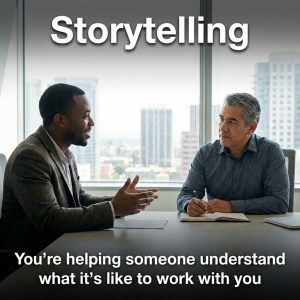 Storytelling does something different.
Stories engage us as humans, not as roles. They pull the listener into a sequence of events, spark curiosity about what happens next, and help us make meaning from experience. This idea is articulated clearly by Ira Glass, who explains how strong stories combine action with reflection on why those actions mattered.
You’re not performing.
With skills-based hiring interviews, you’re helping someone understand what it’s like to work with you.
Using CAR to Support Storytelling
To keep stories focused and easy to follow, a light framework helps: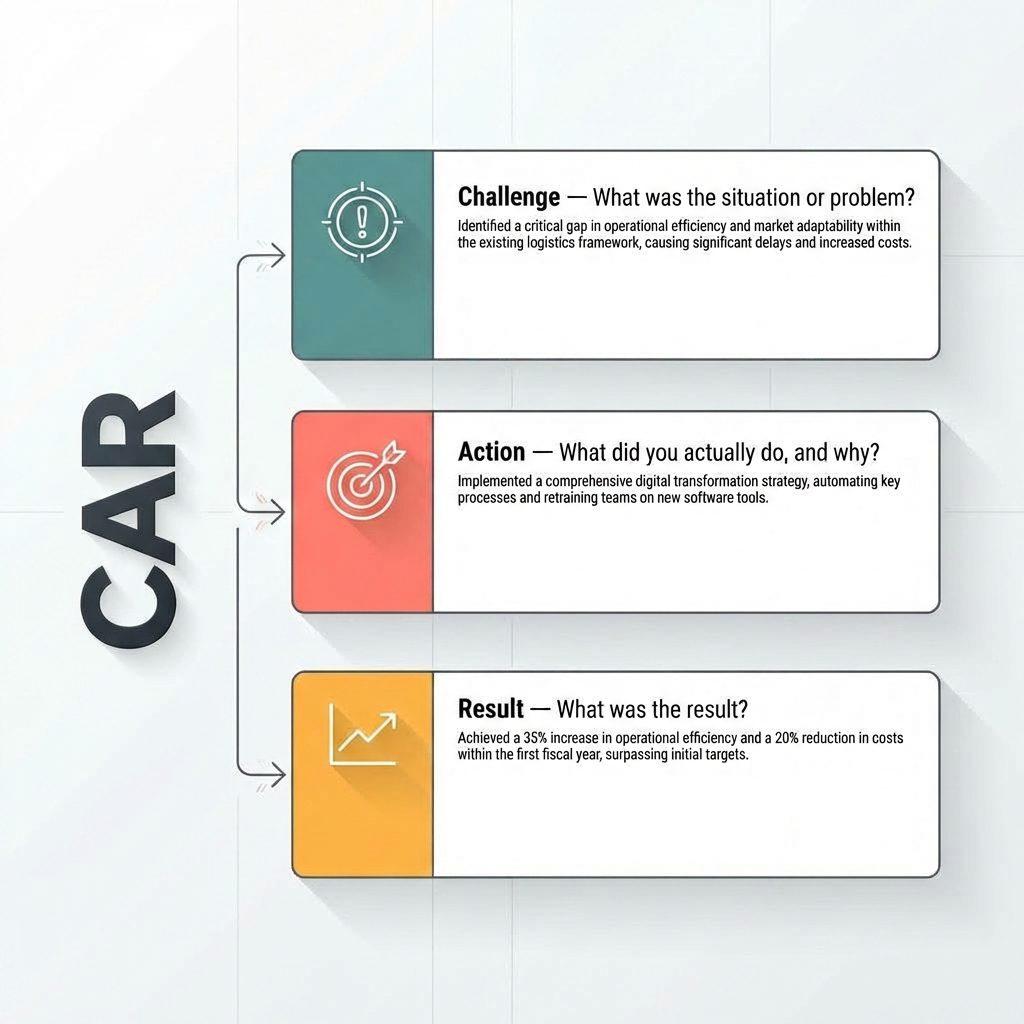
CAR — Challenge | Action | Results
CAR isn’t a script. It’s a way to ensure the essential elements of a story are present, while still sounding natural.
Challenge — What was the situation or problem?
A cross-functional team was missing deadlines because work was being handed off without clear ownership.
Action — What did you actually do, and why?
I mapped the workflow, clarified roles with stakeholders, and established a simple checkpoint to catch issues earlier.
Action — What did you actually do, and why?
Deadlines stabilized, rework dropped, and the team had a clearer sense of accountability.
CAR provides structure to a skills-based hiring interview.
Storytelling creates connection.
Strengths Sound Stronger When They’re Shown
In a skills-based hiring interview, some of the best opportunities to tell a story come from direct questions like:
“What would you say is one of your strengths?”
A strong response names the strength and immediately anchors it in a real situation:
One of my strengths is problem-solving. In one role, new hires were taking far longer than expected to become productive, which was putting pressure on the rest of the team. I reviewed the onboarding process, identified redundant steps, and worked with managers to streamline training and clarify expectations. As a result, onboarding time dropped significantly, and new team members felt more confident much sooner.
The strength is named.
The story makes it credible.
The Bottom Line: Skills-Based Hiring
 Hiring in 2026 means employers are listening for more than experience.
They’re listening for judgment, decision-making, and how someone operates in real situations.
Behavior-based interviewing didn’t disappear. It became more visible—and more influential—across the entire hiring process.
If you’d like help identifying your strongest behaviors or shaping clear, compelling stories for skills-based hiring conversations, I offer a Discovery Session designed to bring clarity and confidence to this process.

Additional Resources
-
Acing Job Interviews Using the Story Toolbox
https://www.youtube.com/watch?v=V5rNzymynbk -
Why Storytelling Works — Ira Glass
https://www.youtube.com/watch?v=5pFI9UuC_fc&list=WL&index=1&t=6s -
Harvard Business Review – Research and practitioner articles on behavioral interviewing, performance prediction, and decision-making
https://hbr.org -
LinkedIn Talent Solutions & Economic Graph – Insights on skills-based hiring, transferable skills, and employer evaluation trends
https://business.linkedin.com/talent-solutions
https://economicgraph.linkedin.com -
Behavioral Interviewing Methodology – Long-standing hiring practice based on the principle that past behavior predicts future performance
https://www.shrm.org/resourcesandtools/tools-and-samples/toolkits/pages/behavioralinterviewing.aspx -
Ira Glass – Storytelling principles explaining how narrative structure creates meaning through action and reflection
https://www.youtube.com/watch?v=5pFI9UuC_fc&list=WL&index=1&t=6s -
Acing Job Interviews Using the Story Toolbox – Practical guidance on structuring interview answers using stories
https://www.youtube.com/watch?v=V5rNzymynbk

0 Comments